Industrial condition monitoring only pays off when the measurement reaches a maintenance
decision. Another dashboard full of blinking lights will not stop your critical assets from
failing without warning — and for many operations teams, that is exactly what the last
telemetry project delivered.
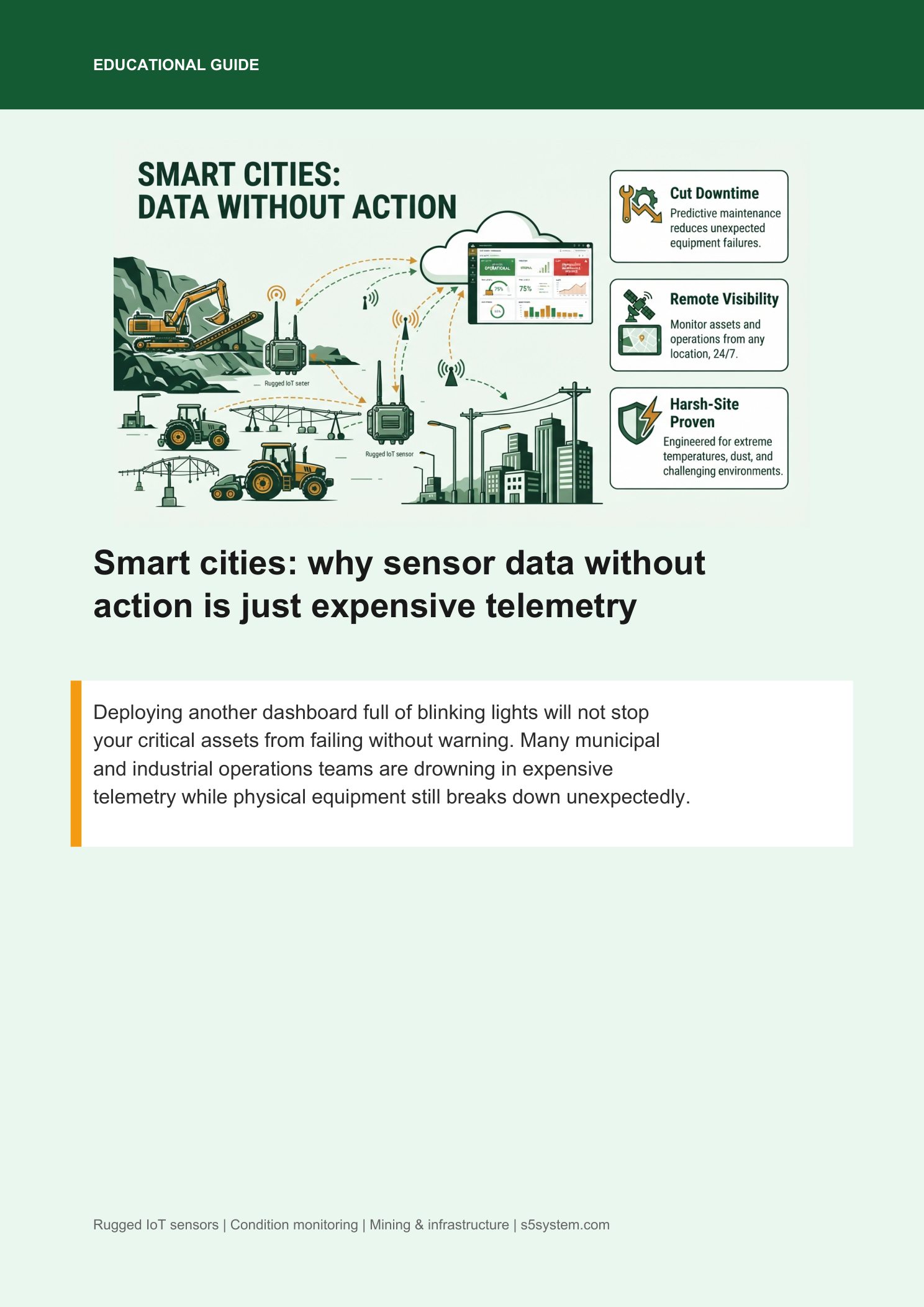
Industrial condition monitoring is a workflow problem, not a data problem
Municipal and industrial teams are drowning in expensive telemetry while the physical
equipment underneath still breaks down unexpectedly. The signal arrives; the action does not.
Most failures do not happen because a team ignored a red light. They happen because the signal
never became a task. An alert lands in a dashboard nobody owns. A vibration trend sits in a
spreadsheet until someone finds time to chart it. A technician walks the same route he has walked
for a decade because that is what the maintenance calendar says.
When off-the-shelf IoT kits are deployed into harsh field conditions, the outcome is
predictable: corrosion, water ingress, flat batteries and dropped links. The budget is spent on
shelfware and disconnected gadgets, engineering hours are burned reconciling contradictory
alerts, and the failures keep coming — this time with a public safety and budget
consequence attached.
What effective condition monitoring actually requires
- Hardware that survives the site. Wide-temperature components, IP68
enclosures, surge isolation and local buffering, so a temporary network dropout does not become a
permanent data gap. - A sensor on the asset that matters. Rotating equipment, wear surfaces,
ground engaging tools, bolt tension — the components whose failure stops production. - A path from metric to maintenance action. The measurement lands in the
workflow planners and reliability engineers already use, with a threshold that means something,
not a raw stream to interpret.
Connecting rugged sensor metrics directly to automated maintenance workflows is what turns
passive data into immediate action. That is the difference between a technology demonstration and
an operational capability.
What a working deployment returns
- Unplanned downtime reduced by up to thirty per cent.
- Hours of manual data checking eliminated every week.
- Functional remote monitoring deployed in days, not quarters.
Choosing where to start
For rotating equipment — motors, gearboxes, pumps, conveyors — start with
RotaMon. For wear surfaces and consumables, see
WearMon. For ground engaging tools on loaders and
excavators, GETsmart reports a detached tooth
upstream of the crusher. For structural and mechanical joints,
BoltWatch measures bolt tension rather than
assuming it. Read more on
mining and resources deployments.
Cross-published from the S5 System LinkedIn stream. Follow us on
LinkedIn for the original post.
Talk to S5 System about your site
S5 System designs and manufactures ultra-low-power industrial IoT sensors —
RotaMon (rotating equipment),
WearMon (wear detection),
GETsmart (ground engaging tools) and
BoltWatch (bolt tension) —
for mining, agriculture, infrastructure and utilities.
Discuss your IoT monitoring project —
book a call.
RotaMon
Wireless, battery-powered vibration, temperature and acoustic condition monitoring for rotating equipment — no cabling, no site infrastructure.
Instrument one critical asset for 90 days and get a defensible condition-monitoring business case you can take to your superintendent. A$4,900, fixed scope, consultancy-led.