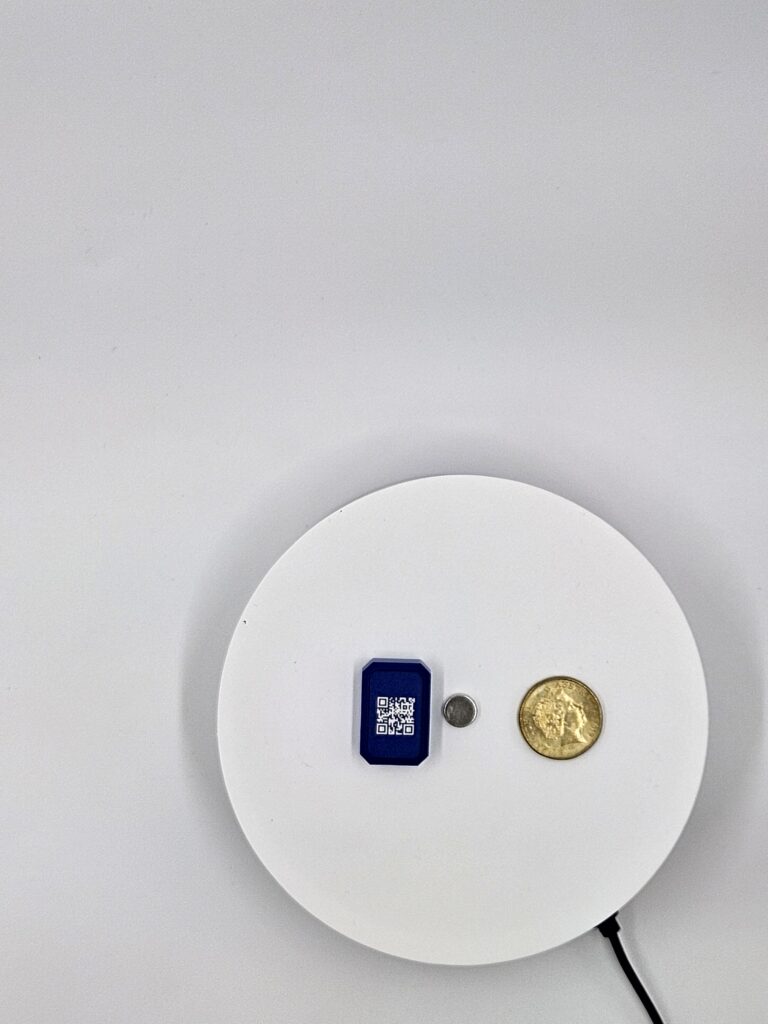
Condition monitoring that prevents failure, not explains it
Most rotating-equipment failures announce themselves before they happen — in the acoustic signature of a failing bearing, the temperature creep of a dry gearbox, the changing vibration profile of a misaligned coupling. The problem is nobody is standing next to the machine at 3am to hear it.
RotaMon is a miniature, hermetically sealed wireless sensor that attaches directly to the machine — bolted or stud-mounted, no cabling, no control-system integration, no site infrastructure. It samples continuously, runs failure prediction on-device, and reports to a dashboard, database and web/mobile application out of the box.
What it monitors
- Vibration — velocity and acceleration, triaxial
- Temperature — surface and bearing-housing trend
- Acoustic signature — on-device machine learning that detects the change in sound characteristic that precedes a vibration signature, giving earlier warning than vibration alone
- Machine health index — reported continuously, with anomaly alerts to operators and maintainers
Applications
Bearings and rotary equipment · reciprocating and displacement equipment · lubrication efficiency · compressors, pumps, fans, conveyors, pulleys, gearboxes, combustion engines, hydraulic power packs — anything high-friction or high-vibration.
Suited to mining, oil & gas, manufacturing and utilities, and to remote or unpowered sites where conventional wired condition-monitoring cannot reach.
Why it is different
- No infrastructure. No gateway to power, no cable runs, no PLC tags. Reports over LoRaWAN/NB-IoT.
- 5-year+ battery life from an ultra-low-power design — without compromising sample rate.
- Non-invasive. Installs in minutes on live equipment. No shutdown to fit it.
- OEM-agnostic. Sits alongside whatever control, SCADA or historian system you already run.
- Engineered for the environment. IP68, sealed against dust, water and vibration.
Condition-monitoring methodology
RotaMon is an instrumentation layer. Where a site operates a Safety Instrumented System, the monitoring data can support diagnostic-coverage and proof-test evidence arguments under IEC 61511 — we are explicit that this is a methodology question (diagnostic coverage, proof-test interval, systematic capability), not a product certification claim. S5 is led by a Certified Functional Safety Expert and will help you frame the evidence correctly.
Instrumentation Pilot — 90 days, one critical asset
We instrument one of your critical assets for 90 days and hand you a
defensible condition-monitoring business case — the evidence pack you can take to your own
superintendent. If the data does not justify a rollout, you have lost a project, not a career.
A$4,900 · fixed scope · consultancy-led
Program review, functional-safety gap assessment, sensor installation and a written recommendation.
No infrastructure required on your site.
Frequently asked questions
Can I monitor a vibrating screen or crusher without running cables?
Yes. RotaMon is battery-powered and wireless, so installation needs no cable tray, no conduit, no junction box and no production shutdown for cabling. A sensor goes on in the time it takes to bolt it on. That matters on vibrating screens, crushers, conveyors and gearboxes where running cable is uneconomic or impossible.
What power and network does RotaMon need on site?
None from the site. The sensor is battery-powered and hermetically IP68-sealed, so it needs no local power and no site network. It transmits over LoRaWAN (long-range, low-power, license-free ISM band) or NB-IoT (cellular) to a gateway or the mobile network. It works on remote assets where power and wired networking do not reach.
How does continuous condition data fit a reliability or functional-safety programme?
RotaMon supplies the continuous condition data that reliability and functional-safety work depends on: it shows how an asset actually behaves between proof tests, so diagnostic coverage and inspection intervals can be reasoned about from measurement rather than assumption. It is a monitoring layer that informs those decisions; it is not itself a safety instrumented function. S5\u2019s functional-safety work is delivered to IEC 61511.