Every week a containerised BESS Australia project sits waiting for AEMO connection sign-off, it
bleeds hard cash through holding costs and impatient investors. The engineering is usually sound.
The compliance path is what stalls.
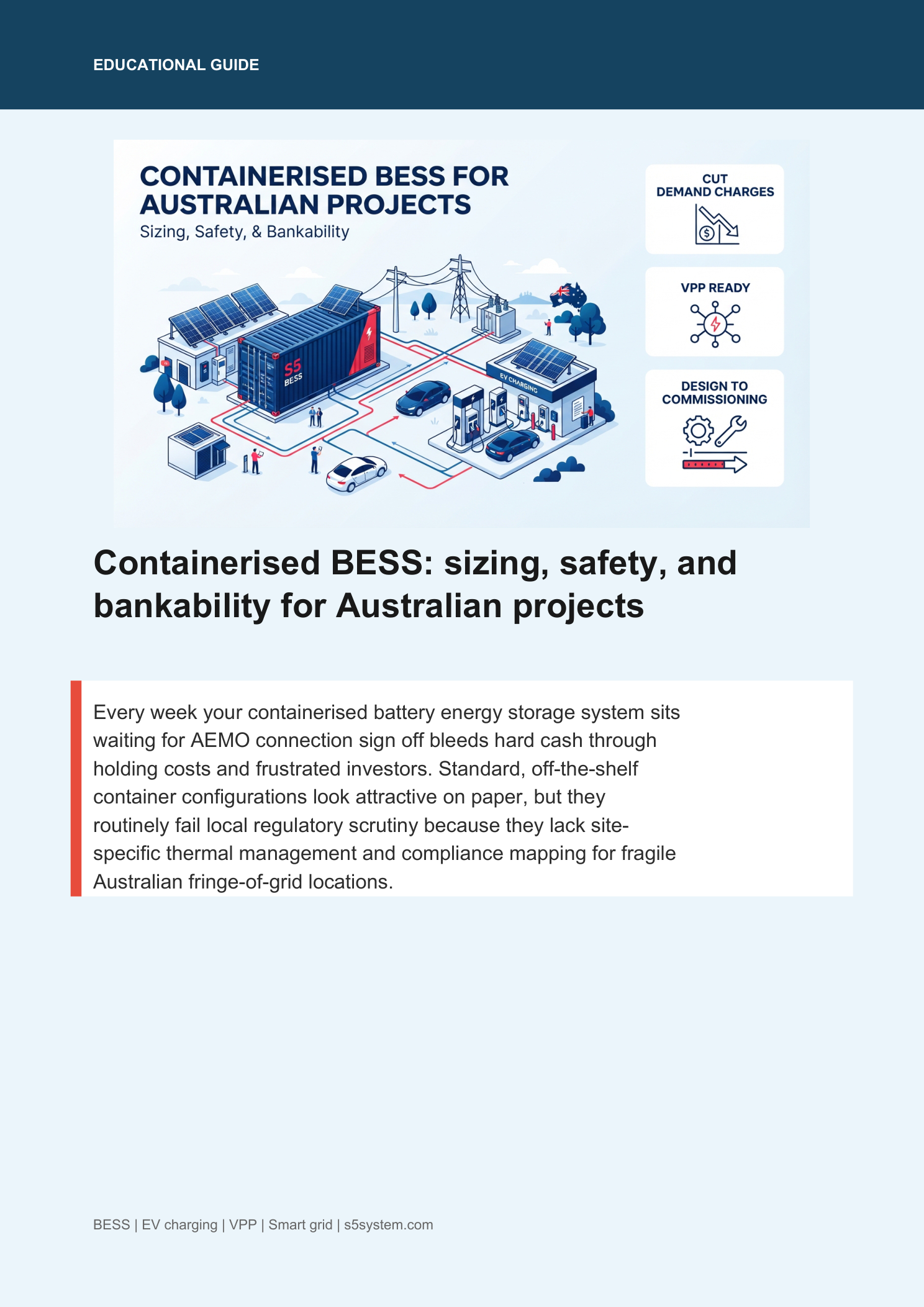
Standard, off-the-shelf container configurations look attractive on paper. In practice they
routinely fail local regulatory scrutiny because they lack site-specific thermal management and
compliance mapping for Australian fringe-of-grid locations. When cybersecurity mandates have to
be reconciled with physical fire safety standards at the same time, commissioning dates slip by
months.
Why the generic container stalls
Australian grid connection is not a single approval. It is a stack:
- Network connection and registration with the market operator, including
performance standards and protection settings. - State and council fire safety requirements, which vary by jurisdiction and
by separation distance, and are not satisfied by a generic enclosure without a site-specific
thermal runaway and suppression design. - Cybersecurity obligations for the control and communications path, which
must be designed in rather than retrofitted onto a system already in commissioning. - Insurance and financing conditions, which in practice demand evidence that
the above are already closed out.
When any one of these is addressed late, the redesign cascades into the others. That is how a
project ends up with burned power purchase agreements and investors losing confidence in the
delivery timeline across the National Electricity Market.
Designing compliance into a containerised BESS Australia deployment
The alternative is to treat compliance, cybersecurity and safety architecture as design
inputs, not review outcomes. Site-specific thermal management sized to the actual ambient
profile. Separation distances and containment designed to the applicable standard rather than
assumed from a datasheet. A cyber-hardened control and telemetry path from the start. A compliance
mapping document that a regulator, an insurer and a lender can all read.
Done that way, the same container arrives on site pre-certified and ready for immediate
deployment, instead of becoming the subject of a retrofit programme.
The outcome you should be able to measure
- Up to a thirty per cent reduction in connection approval timelines.
- Full compliance with local fire safety standards without retrofitting.
- Immediate asset bankability that satisfies Tier-1 lenders.
Where this fits
Containerised energy systems are one part of S5 System’s work in
infrastructure and utilities and
industrial energy. For the engineering and
compliance side, see our
engineering consulting capability and
project delivery track record.
Cross-published from the S5 System LinkedIn stream. Follow us on
LinkedIn for the original post.
Talk to S5 System about your site
S5 System designs and manufactures ultra-low-power industrial IoT sensors —
RotaMon (rotating equipment),
WearMon (wear detection),
GETsmart (ground engaging tools) and
BoltWatch (bolt tension) —
for mining, agriculture, infrastructure and utilities.
Discuss your IoT monitoring project —
book a call.
RotaMon
Wireless, battery-powered vibration, temperature and acoustic condition monitoring for rotating equipment — no cabling, no site infrastructure.
Instrument one critical asset for 90 days and get a defensible condition-monitoring business case you can take to your superintendent. A$4,900, fixed scope, consultancy-led.