Wireless condition monitoring is what turns a raw measurement into a maintenance decision. A common decision point for Australian industrial sites is not a lack of sensors; it is choosing between LoRaWAN and NB-IoT when there are competing options to assess.
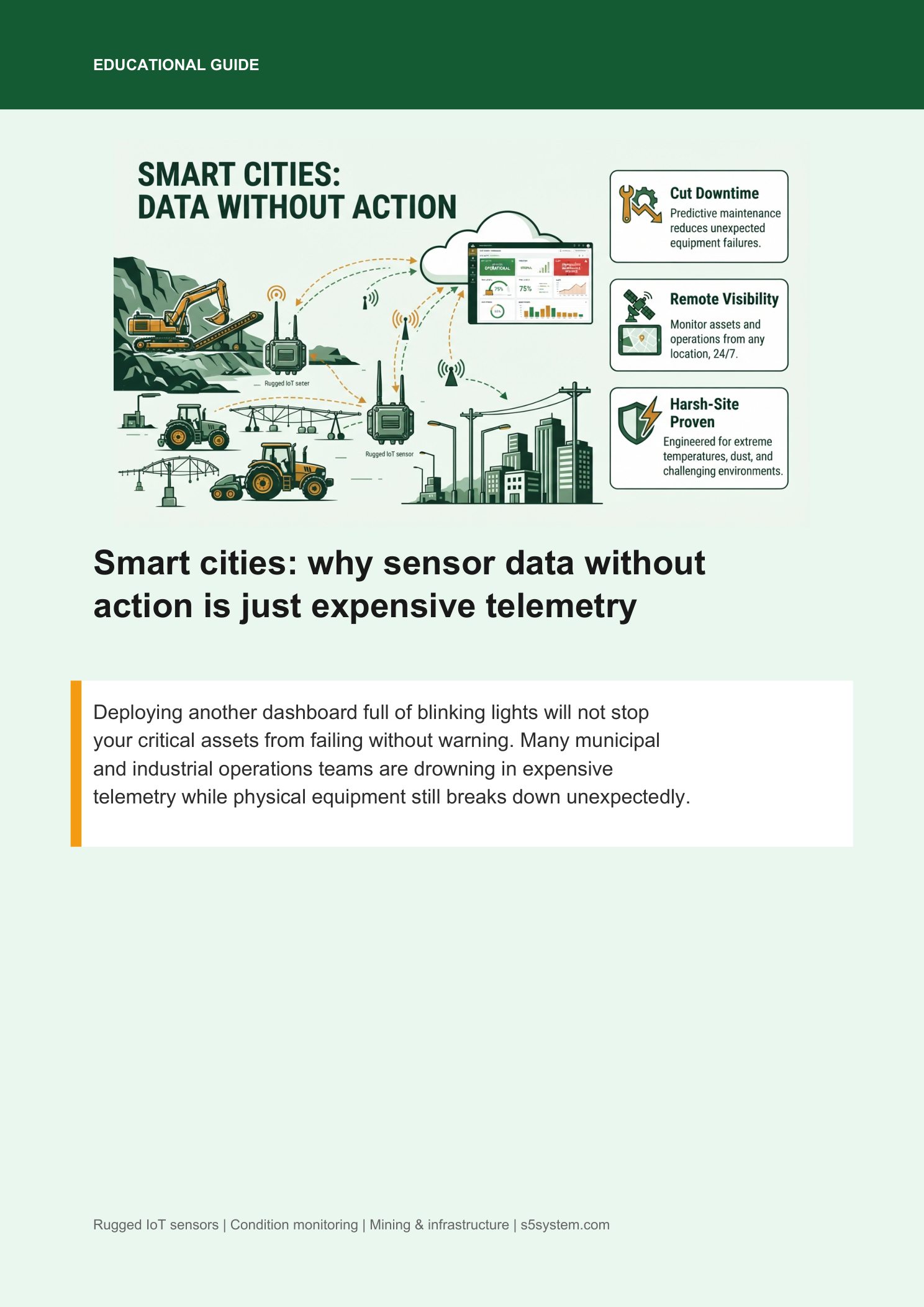
What the problem really costs
Better practice is to assess each site and use case before choosing a network. Remote locations, metal-heavy structures, underground areas and changing operational needs can all affect what will work, so generic coverage claims and DIY comparisons are not a reliable basis for a rollout. The decision should also consider how the network will be supported, secured and expanded.
Closing that gap gives a clearer decision path, site-specific validation before commitment and a practical roadmap for scaling. It also supports reliable reporting to operations and executives, rather than decisions resting on supplier material or assumptions that all sites are alike.
Where the wireless condition monitoring approach differs
S5 provides independent, practical expertise for this decision. We assess each site and use case, compare LoRaWAN and NB-IoT without bias, and shape a rollout plan that avoids tying you to one supplier.
What changes on site
The practical benefits are a clearer decision path, validation that reflects your actual site conditions, and a plan you can expand as operational needs change.
Which sites or use cases would you want to connect first, and what has stopped you moving beyond a pilot?
Getting started
Wireless condition monitoring is not a technology decision, it is an operating decision. The sites that get value from it pick one or two assets that genuinely matter, instrument them properly, and wire the result into a maintenance routine somebody already owns. Start with the failure that costs the most per hour of downtime and work outward from there.
That sequence — one asset, one measurement, one owner — is what separates a programme that survives its first review from another pilot that quietly stops reporting. The engineering is rarely the hard part; sustaining the routine is.
If you are weighing options, bring the failure mode and the cost of an hour of downtime. Those two numbers are enough to scope a first deployment and to judge whether it earned its place at the next budget review.
Where this fits
Published by S5 System. Related capability: S5 System product range, engineering consulting, mining and resources.
Cross-published from the S5 System LinkedIn stream (2026-10-26). Follow us on LinkedIn for the original post.
Talk to S5 System about your site
S5 System designs and manufactures ultra-low-power industrial IoT sensors for mining,
agriculture, infrastructure and utilities.
Discuss your IoT monitoring project —
book a call.
RotaMon
Wireless, battery-powered vibration, temperature and acoustic condition monitoring for rotating equipment — no cabling, no site infrastructure.
Instrument one critical asset for 90 days and get a defensible condition-monitoring business case you can take to your superintendent. A$4,900, fixed scope, consultancy-led.